


March 3, 2026
SUMMARY
Capital spending intentions for non-residential construction in Ontario are set to rise in 2026, driven mainly by the public sector. Government investment continues to outpace private spending and is supporting overall construction activity. The Province’s long term capital plan also points to sustained infrastructure investment over the next decade.
CAPITAL SPENDING SET TO INCREASE IN 2026
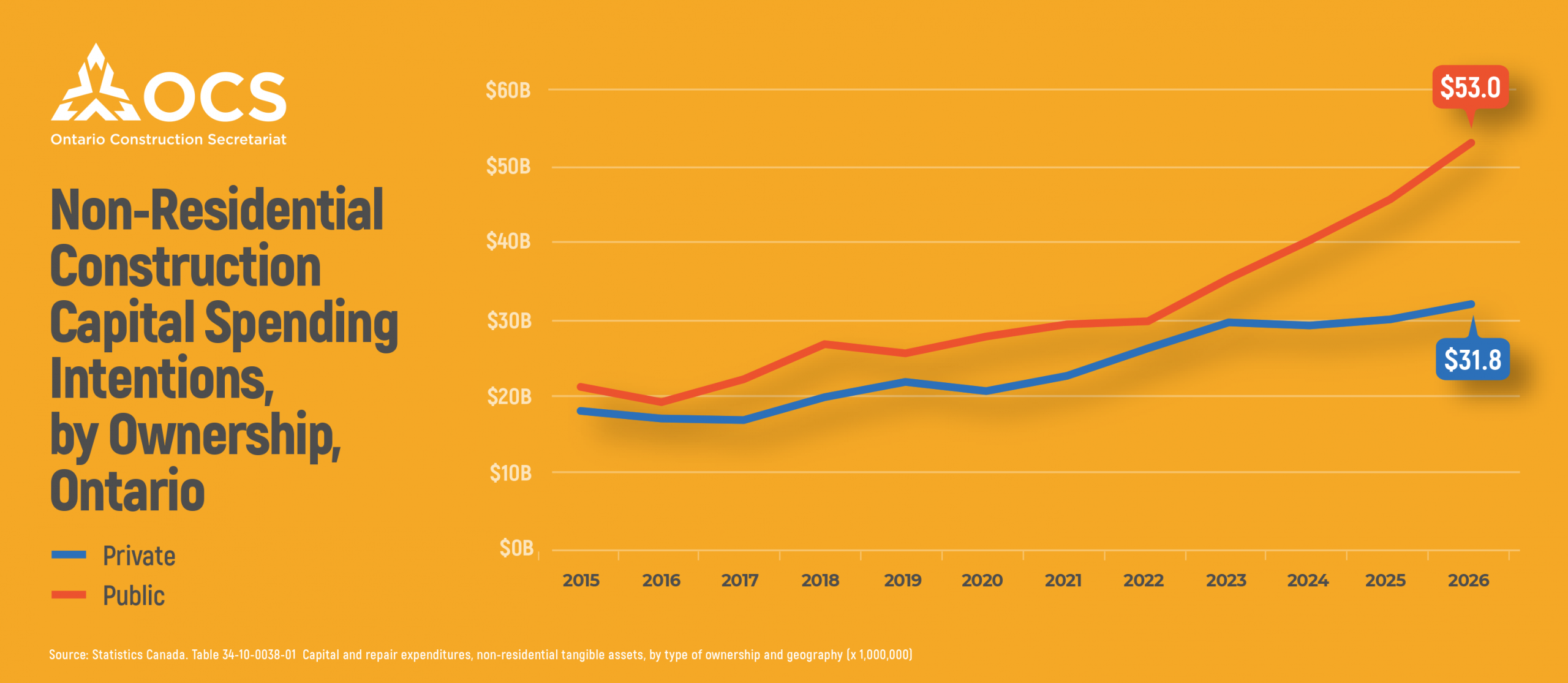
Capital spending intentions for non-residential construction in Ontario are expected to rise by 12.2% in 2026 to $84.8 billion. The increase is largely driven by the public sector.
Public sector spending intentions are up 16.2% compared to last year. In contrast, private sector intentions are rising by a more modest 6% to $31.8 billion. Since the pandemic, the gap between public and private investment has widened. Public spending has acted as a stabilizing force for Ontario’s construction sector during periods of slower economic growth.
WHERE THE MONEY IS GOING
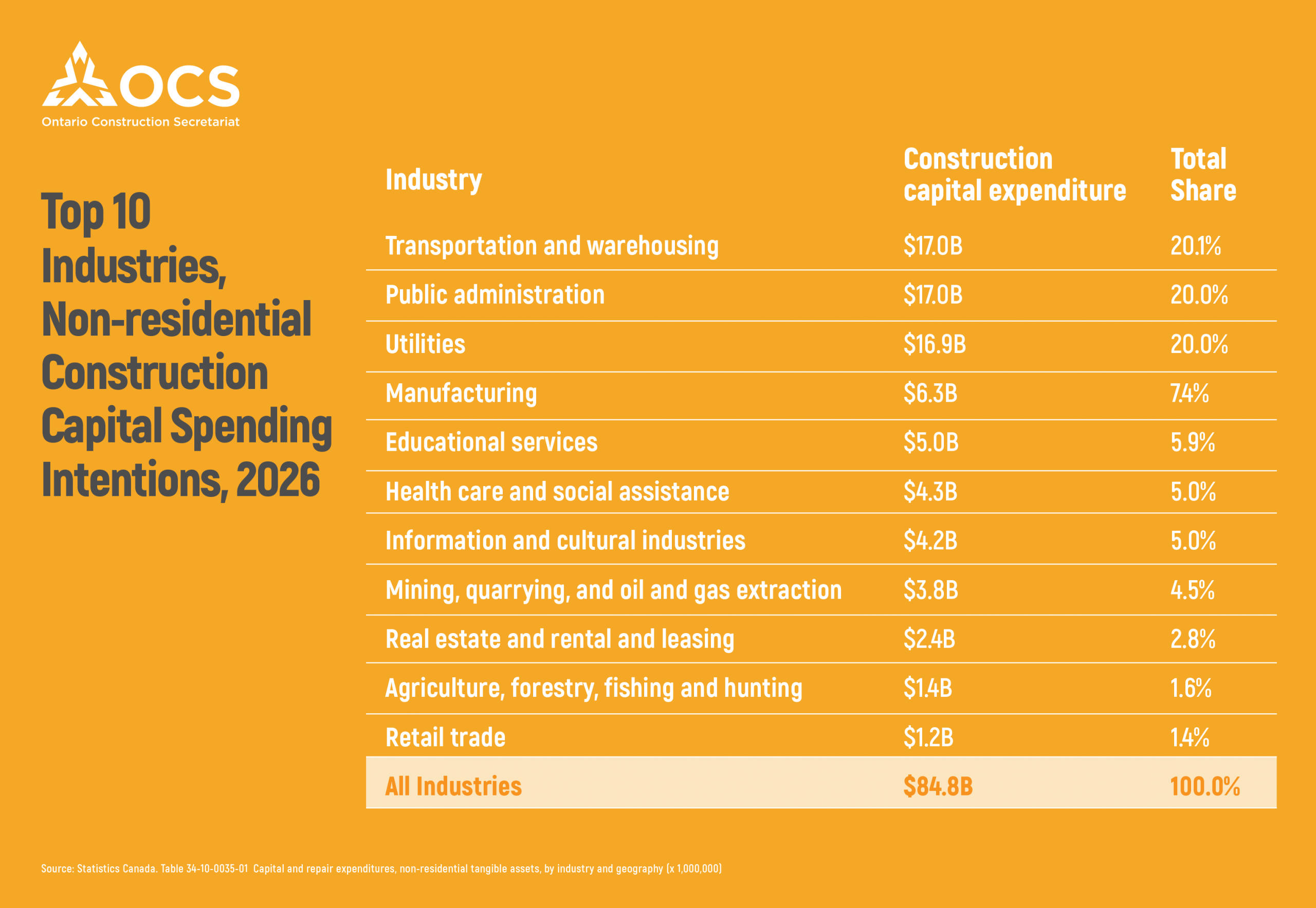
Transportation and warehousing, public administration, and utilities lead capital spending intentions in 2026, each at about $17 billion. Together, these three sectors account for nearly 60% of total planned spending.
Manufacturing, educational services, and health care follow. In growth terms, health care stands out with a 25.2% increase over 2025. Transportation is up 22.6%, and public administration is up 18.9%.
Some sectors are seeing declines compared to last year, including retail trade, management of companies, administrative and waste services, and arts and entertainment.
PUBLIC SECTOR DRIVING GROWTH
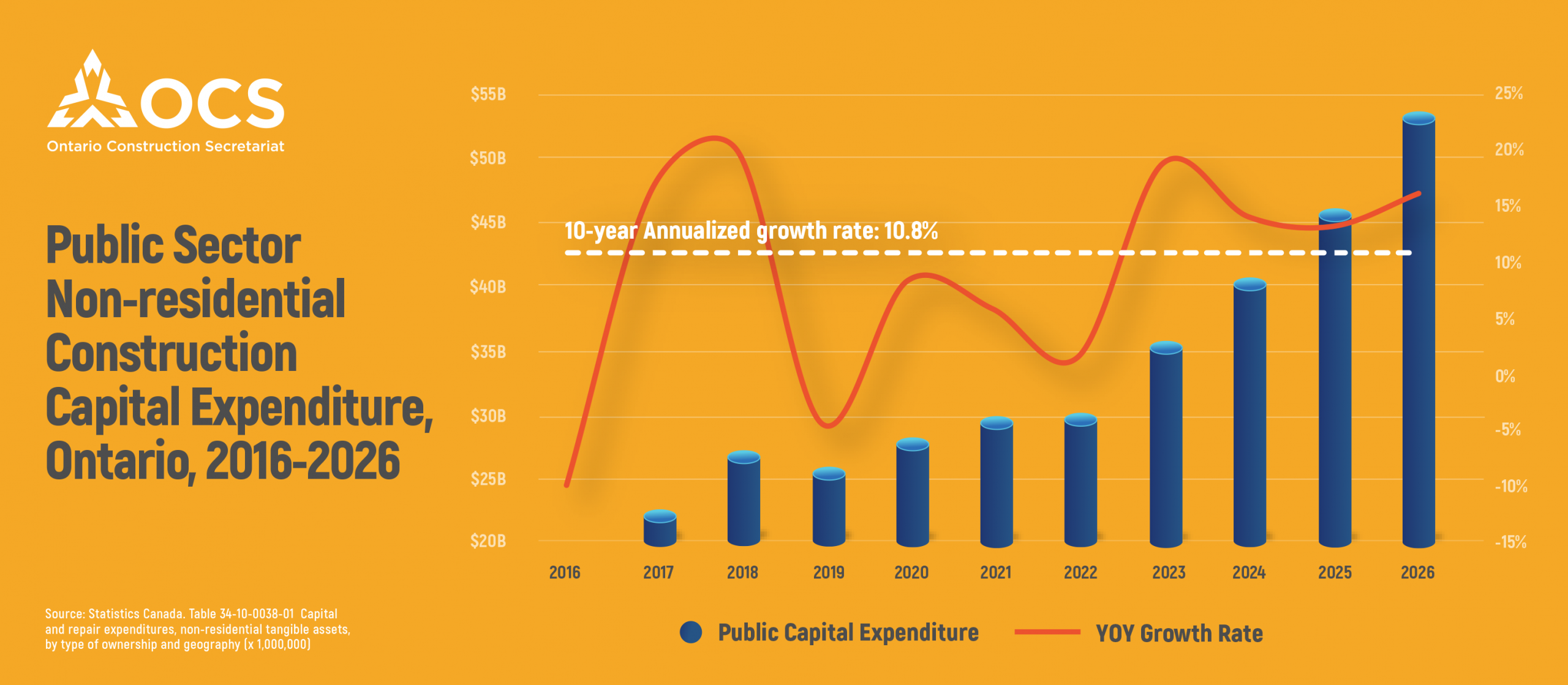
The public sector accounts for 62% of total capital spending intentions in 2026. Public capital expenditure has been on a strong upward trend, with recent annual growth rates exceeding the 10-year average growth rate of 10.8%. Current double-digit growth of 16.2% suggests a strong project pipeline and continued government support for infrastructure development.
 ONTARIO’S 10-YEAR CAPITAL PLAN
The 2025 Ontario Budget outlines a 10-year capital plan totaling $223.1 billion in nominal terms, or $203.4 billion in real 2025 dollars. Of the total plan, 86% ($191.1B) is allocated to provincially owned capital assets such as hospitals, schools and highways, while 14% ($31.9B) reflects capital transfers to external entities. The Province is expected to fund 83% of the total cost, with the balance coming from federal, municipal and third-party contributions.
From a construction perspective, 57% ($128.2B) of planned spending is directed toward expansion projects, with the remaining 43% ($94.9B) allocated to renewal and modernization of existing assets.
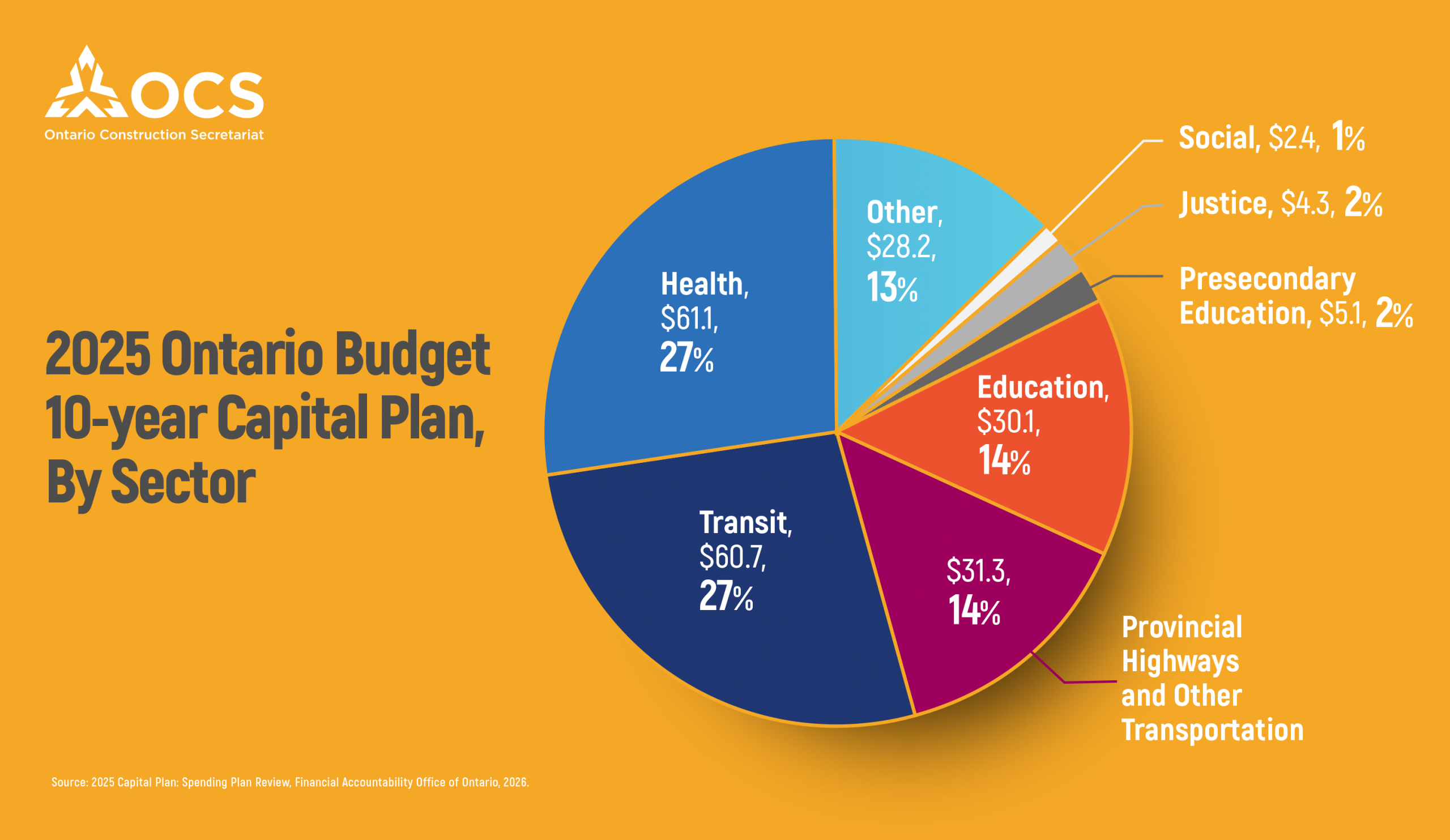
Sectorally, health (27%) and transit (27%) account for the largest shares of total investment, followed by highways and transportation (14%), education (13%), and other infrastructure (13%), with smaller shares in postsecondary education, justice and social infrastructure.
In real terms, the 10-year plan is 17.9% higher than the 2019 capital plan, though it is broadly in line with actual spending over the past decade (-0.8%).
Overall, the plan signals sustained and historically elevated public construction outlays, with a significant share directed toward system expansion alongside continued renewal investment.
____________________________
FOR MORE INFORMATION, CONTACT:
Gargi Bharti
Economic and Research Project Lead
Ontario Construction Secretariat (OCS)
180 Attwell Drive, Suite 360, Toronto, ON M9W 6A9
P 416.620.5210
gbharti@iciconstruction.com