


May 14, 2026
SUMMARY
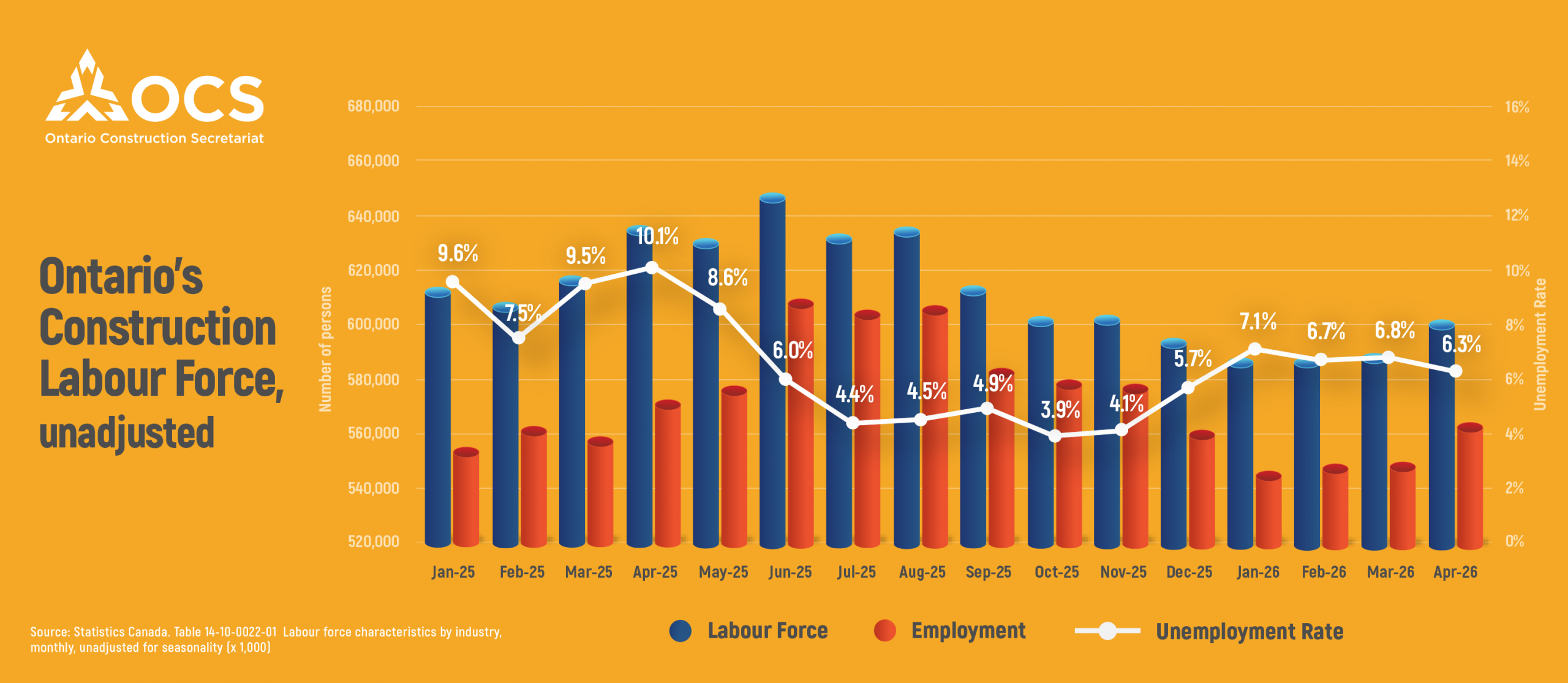
Ontario’s construction labour market improved modestly in April, with employment increasing and the unemployment rate declining compared to March. However, both employment and labour force levels remain below last year’s levels, reflecting ongoing labour supply challenges. The decline has been most pronounced among younger workers.
LABOUR MARKET OVERVIEW
The unemployment rate in Ontario’s construction sector was 6.3% in April, down from 6.8% in March. Employment increased by about 14,100 compared to the previous month. However, total employment remains 1.5% lower than a year ago, representing a decline of about 8,500 jobs.
Despite lower employment levels, the unemployment rate improved significantly compared to April last year, when it stood at 10.1%. This suggests that the labour force was considerably larger a year ago. Over the past 12 months, Ontario’s construction labour force declined by 5.4%, or approximately 34,400 workers.
COMPOSITION OF THE LABOUR FORCE
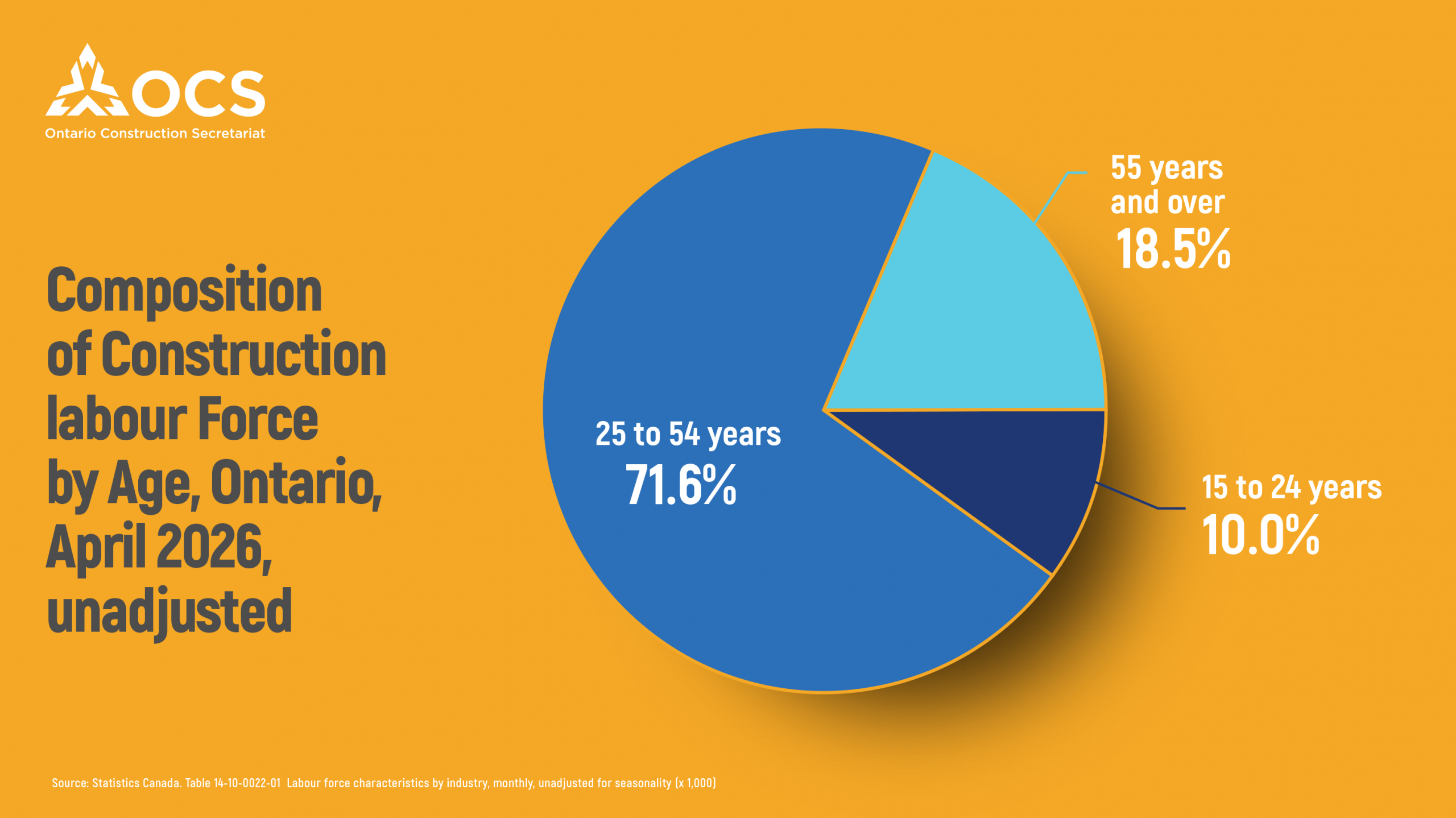
The decline in the labour force has affected age groups differently. The number of youth workers aged 15 to 24 fell sharply by 21,600 over the past year. Employment among workers aged 55 and over also declined by 8,800. Unlike last month, the core working-age group aged 25 to 54 also recorded a decline, falling by approximately 4,000 workers.
In terms of labour force composition, youth account for 10% of the construction labour force, workers aged 25 to 54 represent 71.5%, and workers aged 55 and over make up 18.5%.
Unemployment rates also vary by age group. Youth unemployment remained elevated at 12.7%, although it was lower than the previous month. Workers aged 55 and over had the lowest unemployment rate at 5.0%, despite an increase from 3.8% in March. The core working-age group recorded an unemployment rate of 5.8%, close to the provincial construction average.
WOMEN IN CONSTRUCTION
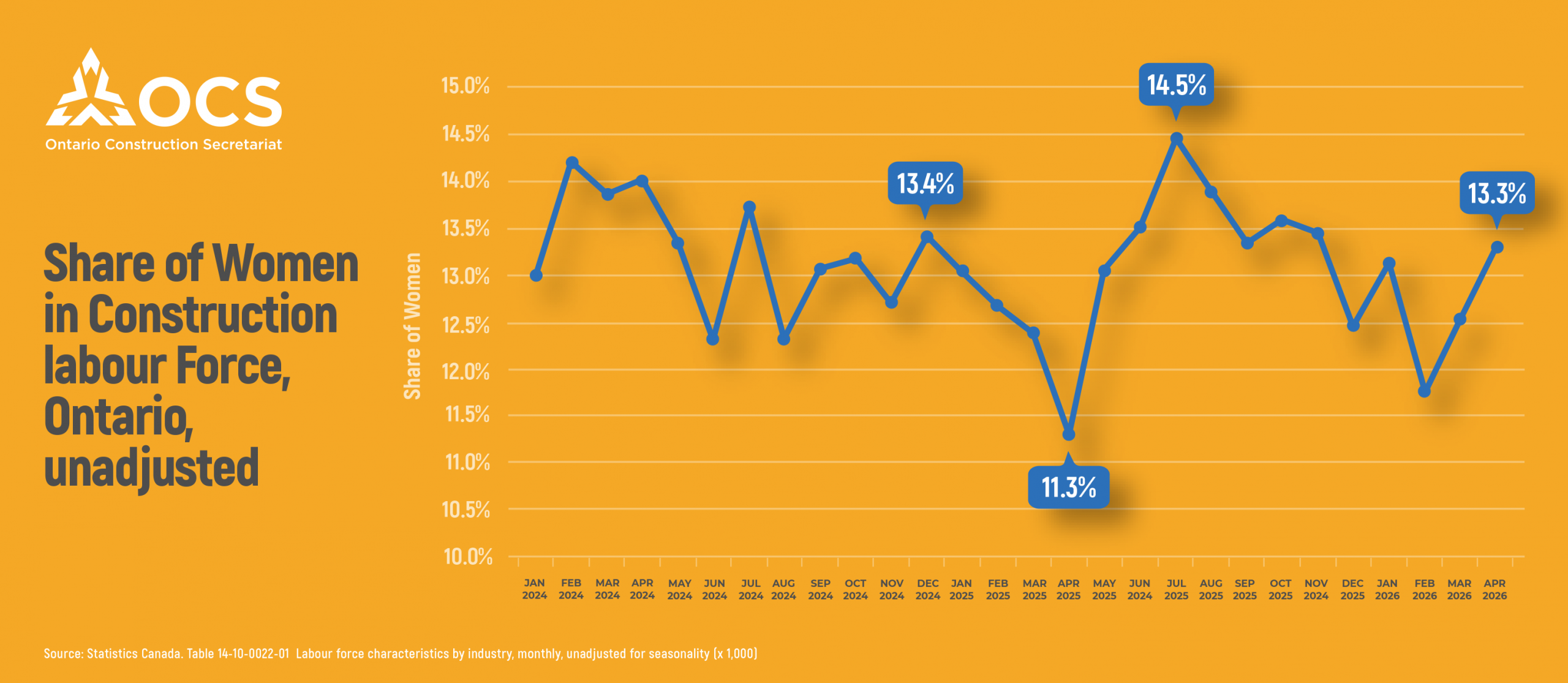
Women accounted for 13.3% of Ontario’s construction labour force in April, consistent with the long-term average. By comparison, women represented 47.2% of the labour force across all industries.
The number of women employed in construction increased by 8,100 compared to the same month last year, representing an 11.3% increase. This growth contrasts with the overall decline in construction employment over the same period and suggests that women continue to strengthen their presence in the sector, even as overall labour force levels weaken.
Women in construction also recorded the lowest unemployment rate among all major demographic groups in April 2026, at 3.8%.
____________________________
FOR MORE INFORMATION, CONTACT:
Gargi Bharti
Economic and Research Project Lead
Ontario Construction Secretariat (OCS)
180 Attwell Drive, Suite 360, Toronto, ON M9W 6A9
P 416.620.5210
gbharti@iciconstruction.com