


November 5, 2026
SUMMARY
Ontario’s non-residential building construction prices increased 4.3% year over year in Q3 2026, with a further 1.1% increase from the previous quarter. Annual price growth eased slightly from Q2, although construction costs continued to rise.
Industrial construction recorded the strongest annual price growth among the three ICI sectors, while regional differences remained significant. At the construction division level, conveying equipment and structural steel framing experienced some of the largest price increases.
NON-RESIDENTIAL BUILDING CONSTRUCTION PRICE INDEX
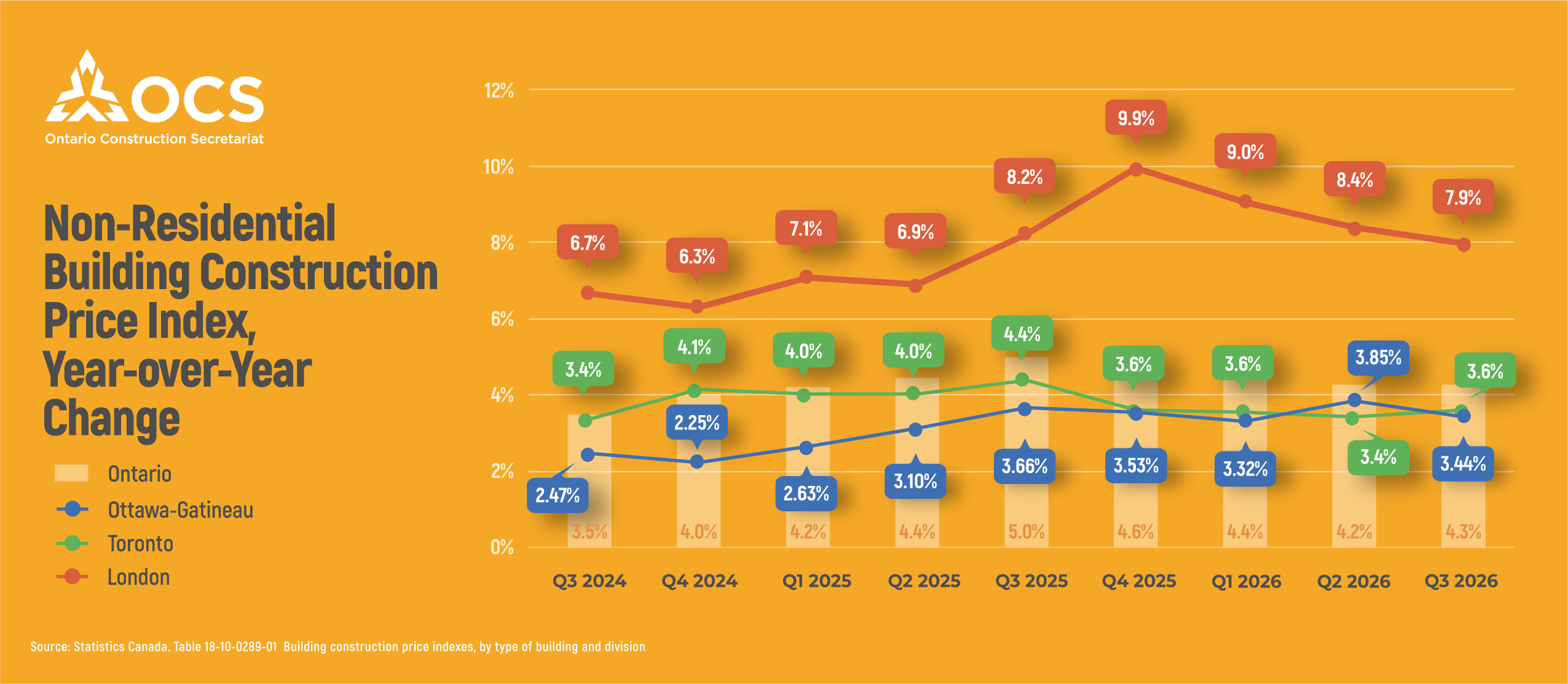
Ontario’s non-residential Building Construction Price Index (BCPI) increased 4.3% year over year in Q3 2026, while prices rose 1.1% compared with the previous quarter.
According to Statistics Canada, builders across Canada reported rising material, fuel, transportation and labour costs, alongside skilled labour and subcontractor capacity pressures, particularly in Atlantic Canada and the Prairies. Statistics Canada also noted that changes to Canadian retaliatory tariffs on U.S. products, including steel and aluminum, added to construction cost pressures.
Price growth varied across Ontario’s major markets. London recorded the strongest annual increase at 7.9%, compared with 3.6% in Toronto and 3.4% in Ottawa–Gatineau (Ontario part).
London’s higher price growth can partly be explained by its construction mix. Factory construction accounts for 73.4% of London’s non-residential BCPI, compared with 14.1% in Toronto. Concrete and structural steel framing within factory construction also carry significantly greater weight in London’s index, together accounting for 38.2%, compared with 6.9% in Toronto. These divisions experienced particularly strong annual price increases in London, with structural steel framing rising 15.5% and concrete increasing 8.1%, likely contributing to the region’s higher overall construction price inflation.
PRICE TRENDS WITHIN THE ICI SECTOR
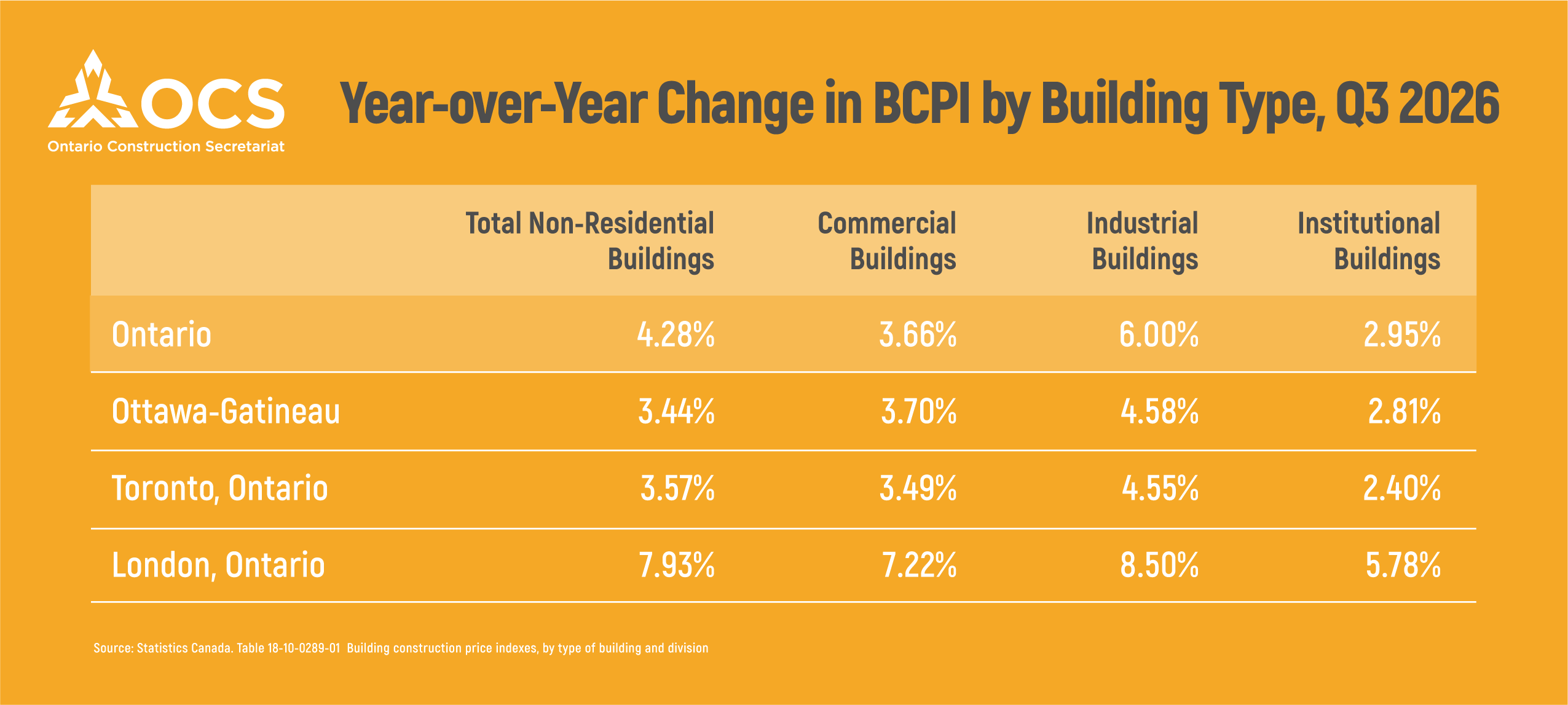
Industrial construction recorded the strongest annual price growth in Ontario, with prices increasing 6.0% year over year in Q3 2026.
Commercial construction prices rose 3.7%, while institutional construction recorded the smallest increase at 3.0%.
The pattern was broadly similar across Ontario’s major markets, although the pace of growth differed considerably. London recorded the highest increases across all three sectors, with industrial construction prices rising 8.5%, commercial prices increasing 7.2%, and institutional prices growing 5.8%.
COST CHANGES BY CONSTRUCTION DIVISION
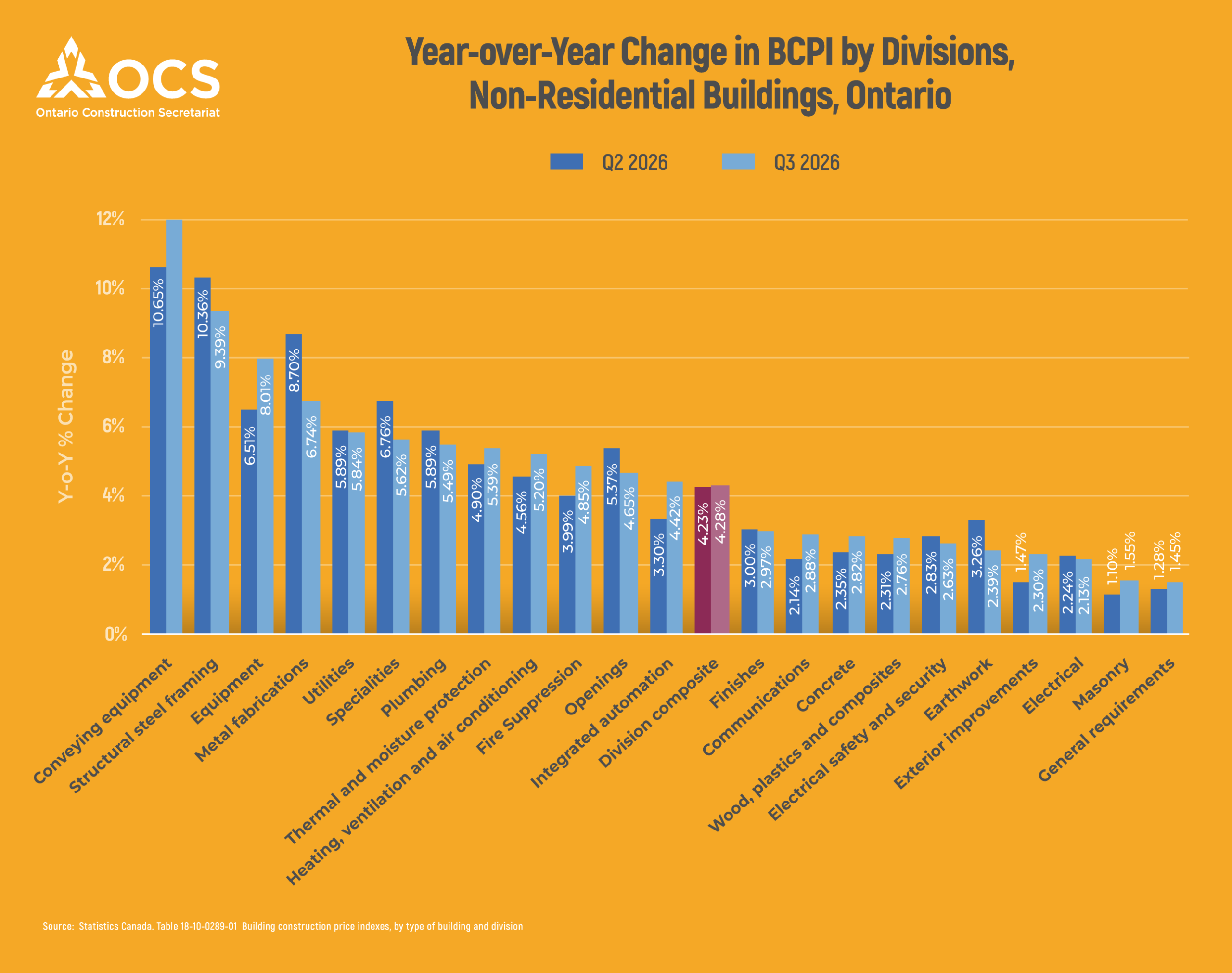
Construction price changes varied across divisions in Q3 2026, with structural and equipment-related work recording some of the largest annual increases.
Conveying equipment recorded the strongest year-over-year increase at approximately 12.0%, followed by structural steel framing at 9.4% and equipment at 8.0%.
Several divisions experienced stronger annual price growth compared with the previous quarter. Equipment increased from 6.5% in Q2 to 8.0% in Q3, while thermal and moisture protection rose from 4.9% to 5.4%. In contrast, metal fabrications slowed from 8.7% to 6.7%, and earthwork eased from 3.3% to 2.4%.
Looking at the latest quarterly movements, structural steel framing recorded the largest increase at 2.7%, followed closely by conveying equipment at 2.7%. Concrete prices increased by a more moderate 0.6%.
____________________________
FOR MORE INFORMATION, CONTACT:
Gargi Bharti
Economic and Research Project Lead
Ontario Construction Secretariat (OCS)
180 Attwell Drive, Suite 360, Toronto, ON M9W 6A9
P 416.620.5210
gbharti@iciconstruction.com